
A Christian Guide to the Qur’an

In the world we live in, it can be difficult to find information that you can trust. It’s hard to know who to believe, and even many authors have their own agendas. With that in mind, I wanted to offer readers of this blog some suggestions for books that I found in-depth but not overly scholarly, helpful but not condescending, and innovative but not erring. One such book is “A Christians Guide to the Qur’an” by Raouf and Carol Ghattas.
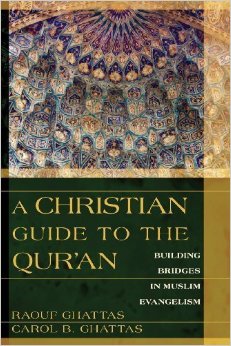
book_imageSubtitled “Building Bridges in Muslim Evangelism,” Raouf and Carol Ghattas take a detailed walk through the entire Qur’an. At each stage, they stop to highlight key verses that can be used as areas to further discussions between Christians and Muslims. For the most part, the comments on each surah of the Qur’an are geared to help Christians know how to build bridges with Muslims. This is done by suggesting what part of the Bible shares more information about the content within the Qur’an. In nearly every case, the Qur’an will briefly touch on a historical account, but most of the details of the encounter are missing. By returning to the Biblical account, much more detail can be brought to bear on the topic under discussion. The idea is that by taking this approach, Muslims are exposed to Biblical narrative in a positive and acceptable manner.

While the primary vehicle of conversation is providing more information from Biblical accounts when compared to the Qur’an, the authors do note other items, such as contradictions within the Qur’an as well as places where the Qur’an teaches something opposite to that of Christianity. Of course for me, it is these highlighted areas of difference that I found most interesting. The authors are very respectful in the way these discrepancies are presented. They mention what the Qur’an says, refer to what the Bible says, and then just comment regarding how the two are at odds with each other. For those areas where the Qur’an contradicts itself, the authors just note the other Qur’anic passage and what was said. They do not advocate using such information to beat Muslims over the head with polemic arguments. Rather, the authors suggest a gentler approach of asking questions that will cause Muslims to think for themselves, thus questioning their own beliefs.

As far as content, I found the book very accurate and informative. The authors do a systematic job of analyzing the Qur’an surah by surah paying particular attention to Islamic commentators in order to present a fair and balanced approach to interpretation. Not once did I find a place where I disagreed with the factual content of the information presented.

In general, the book was helpful, thoughtful, and insightful. I did have a few minor issues with the book. One was that often the comments were repetitive. This isn’t always the fault of the authors, since the Qur’an itself is repetitive, so often there is nothing new to add when approaching a new surah. In this respect, the authors are bound to the format of the Qur’an when presenting material about responses. Another aspect of the book I found that could have been better was more focus on the significance of the theological differences between Islam and Christianity. However, I understand that this was not the authors’ focus nor intent. The main point of the book was to help Christians understand what is in the Qur’an so as to have more informed conversations with our Muslim friends and neighbors. Focusing too much on theological differences could have created a confrontational air, which the authors wanted to avoid.

I would recommend this book to someone who only knew a little about Islam and wanted to get a better handle on what is in the Qur’an. The book is both a quick read as well as a great reference. The material is systematically organized, factually accurate, and useful for helping people have fruitful conversations with Muslims.

Posted in Unraveling_Islam | Tagged | 2 Comments

Perfume and Salt

Frequent readers of this blog know I focus on the theological differences between Islam and Christianity. Yet I know that there are many people who see the two religions as quite similar. The question must be raised as to why this is so. Certainly their perception is born out of some amount of data. Perhaps it isn’t accurate or complete, but it must come from somewhere. I recently received some insight on why this might be so.

This past week I went to the local mosque after a fairly long hiatus. I am always intrigued to hear what the khutbah, or message, will be about. This past week it was about how Muslims should interact in the world in which they live. Both toward Muslim brothers, as well as toward those on the outside, Muslims were instructed to make a positive difference in the world in which they live. Several examples were given about Muslims of history. Hadith from the life of Muhammad were quoted regarding things he did to help those around him, and concrete steps were given for how Muslims could operate today to make such a positive impact on the world.

One parable given as an illustration was that of perfume. When perfume is used, it permeates all of its surroundings. Scents move through the air indiscriminately, affecting every corner, every space, until the entire area is saturated with its smell. The message continued that this is how Muslims are to be, a beautiful scent that penetrates into every part of the world. In essence, be a sweet smelling fragrance to everyone around you.

Does this sound familiar? Of course it does. Paul used this metaphor when speaking of how the gospel should be spread (2 Corinthians 2:14). Jesus preached that as Christians we should be a positive force for change in our world, and He relates other examples that got the same point across. For example, he called us to be light in the midst of a dark world (Matthew 5:15-16). Light always brightens an area, regardless of how dark it is (Luke 11:36). Another parable Jesus tells to illustrate this point is that of salt. In Mark 9:50 and elsewhere, Jesus admonishes us to be like salt. Salt has the property of both seasoning as well as preservation. So too, salt infuses itself into every bite of food. It works its way through the entire portion.

It’s no wonder people see Islam and Christianity as being so similar. If I went to a mosque and heard a khutbah about being perfume in the world, and then went to a church and heard a sermon about being salt and light in the world, what else would I conclude? The point is the same. The only difference is that the parables choose distinctive substances that each have penetrating qualities.

Yet perhaps more illustrative is what this says about the culture of our day. You can go to many liberal churches where you will hear the same type of sermon preached. Be kind to others, lend a helping hand, be generous, and leave the world a better place than you found it. These are admirable intentions, and to be sure, qualities we all hope everyone possesses in abundance. But by themselves do they constitute a religion?

Where does faith come into play? What is its role? Without Jesus’ redemptive action on the cross, what point is there in all of our efforts? God tells us that our work apart from Him isn’t worth anything (Isaiah 64:6). Do our good deeds, done in the flesh according to the law, please God who calls us to walk in the Spirit? (Galatians 5:4) The Bible is clear that our acts done apart from God are at constant war with what it means to follow Him by His Spirit (Galatians 5:17). Making the world a better place is a wonderful and admirable goal. Yet it’s no better by itself apart from faith than it is for faith to by itself apart from works (James 2:17). Trying to curry favor from God by spreading good intentions, whether we are inspired by the parable of perfume or light or salt, is a non-starter; without Jesus’ redeeming work on the cross, those efforts may help the physical world, but are dead spiritually.

So do many Christians see similarities between Christianity and Islam for good reason? Yes, they do. If their experience or understanding of Christianity comes from sources outside those which preach the incarnation, the crucifixion, and the resurrection, they could well draw such a wrong conclusion. Our good works should come from the Holy Spirit who works within us, who was given to us as a down payment on our inheritance which is yet to come (Ephesians 1:14). Understanding God’s work through Jesus sheds an entirely different light on why we strive to be salt and light (or perfume) to others (Galatians 2:21).

Posted in Unraveling_Islam | Tagged | 1 Comment

The Evil Eye

Many of the articles that I write for this blog are quite theological and abstract in nature. However, to truly understand people, both their actions as well as their beliefs must be taken into account. Often belief and practice don’t align, whether people are Christian or Muslim. There are often discrepancies between doctrine and praxis, and these aren’t unique to Islam. Nevertheless, to get a fuller understanding of the differences between Christianity and Islam, some less known Islamic practices should be investigated. Many Muslims adopt cultural and superstitious beliefs, some of which gain credibility from the Hadith.

One such superstition that impacts Muslim lives is the evil eye. In English, the term “evil eye” refers to an intense look of anger, but the term has an entirely different meaning in the Middle East. This article in no way discusses the English usage of the term, but rather the Islamic view of the idiom. The evil eye is defined as follows:

The fundamental concept of the evil eye is that precious persons or things are constantly vulnerable to hurt or destruction caused by other people’s envy. Such envy or jealousy is projected through the eye. [i]

The Islamic concept of the evil eye is when anyone looks with covetousness or envy at someone else’s property, family, or even the person himself. This envious look is viewed as causing direct harm to the object envied. Muslims fear its effects and protect themselves against it through a variety of amulets, talismans, and charms. The Internet is littered with questions by Muslims regarding how to ward off the evil eye. [ii] In The Unseen Face of Islam, Bill Musk gives some examples of the effect. One Muslim told a story about how someone had enviously eyed their family’s new cow, and it stopped giving milk from that day forward. Often, medical professionals who cannot make a diagnosis will blame someone’s ailment on the evil eye.

The Qur’an does not talk about the evil eye specifically, but Muhammad does. Sahih Bukhari, book 71 is devoted to medicine. In it Muhammad is reported to have stated that the evil eye is a fact {iii] and he specifically diagnoses some problems as having originated from the evil eye. {iv} The bottom line is that many Muslims live with the idea that a covetous glare from someone else can impact their life, prosperity, or relationships negatively. For this reason, open declarations of envy are to be avoided.

On the surface this aversion to envy would seem in agreement with that of Christianity. In Islam, the Qur’an mentions coveting as a sin in chapter 4, verse 32. In the Bible, in Exodus 20:17, God gives the command not to covet your neighbor’s wife, your neighbor’s property, nor anything that your neighbor has. So it would appear that the religions are similar, in that both would be advocating its adherents not to covet.

However, a deeper investigation reveals something less obvious. The Bible is full of warnings about covetousness, yet some churches rarely preach about it from the pulpit. The Bible is full of admonitions and explanations of the harmful nature of covetousness. Covetous actions have severe consequences, and one such example is in 2 Kings 5, where Elisha refuses a gift from Naaman, but Elisha’s servant Gehazi chases after him to score economic gain. The consequences for Gehazi are swift and severe (2 Kings 5:27).

The New Testament is equally serious about guarding yourself against this attitude of covetousness. God teaches us throughout His Word that covetous people will not have any part in His eternal Kingdom (Ephesians 5:5). That’s a very serious pronouncement. Coveting the world’s treasure creates alienation from God. (Matthew 6:24). It is lumped in with some nasty other sins, including selfishness (2 Timothy 3:2). It can cause us to mock the truth of God’s Word (Luke 16:14). It is wholly unprofitable (Matthew 16:26). It can cause us to miss divine appointments (Luke 14:18). It disqualifies us from positions of ministry (1 Timothy 3:3). In the end, covetousness is the same as idolatry (Colossians 3:5) and because of it, we are deserving of God’s wrath (Colossians 3:6).

So how do Christianity and Islam compare when it comes to covetousness? Remember, in Islam, one of the common practices is to guard oneself against the evil eye of others. The harm done by the evil eye is inflicted on the person whose property is being coveted. In the Bible, the consequences for such envy are inflicted on the one doing the coveting. In Islam, the harm occurs to the victim. In Christianity, the harm occurs to the wrongdoer.

Of course in Christianity, covetous behavior does cause collateral damage. In Islam, envy would also be considered a sin. Yet, when you look closely at how the practice of dealing with envy occurs, a marked difference appears. The Bible makes it clear that harm falls on the one with the evil eye; in Islam, Muslims guard themselves from the harm believed to be transferred from others who exhibit envious behavior. .

[i] Musk, Bill. The Unseen Face of Islam. Grand Rapids, MI: Monarch Books, 1989, p23.

[ii} http://www.islamweb.net/emainpage/index.php?page=showfatwa&Option=FatwaId&Id=7151

[iii] http://www.searchtruth.com/book_display.php?book=71&translator=1&start=0&number=635#635

[iv] http://www.searchtruth.com/book_display.php?book=71&translator=1&start=0&number=634#634

Posted in Unraveling_Islam | Tagged | 1 Comment